|
26A022 A Very Notable Book by Jim Davies, 6/2/2026
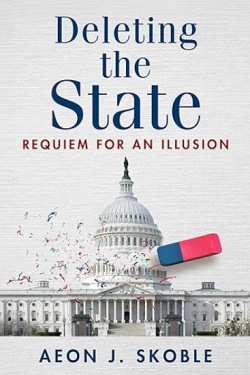
First written in 2008 and recently updated and re-issued as a second edition, Dr Skoble has produced a most valuable contribution to anyone wondering if there might be a viable, rational alternative to the existing top-down, governed society that now prevails everywhere. Until received as a welcome birthday gift I'd never heard of it or him, and the blame is mine. Its title is exactly what needs to be done and the text, I found, is right in line with my own understanding, but presented in a very appealing, winsome and scholarly way. It's an excellent book to bring to any friend who still supposes that government is "necessary." Dr Skoble is a professor of philosophy and my immersion in that discipline has been only ankle-deep; so this review will probably fall short of doing his book justice. However I'll persevere, because it deserves to be better known. Deleting traces the importance of individual rights to the earliest philosophers, and attributes the competing Hegelian view to the "Hobbesian Fear" - that is, the fear that without the supreme authority of a State, human interactions would be shambolic; for example, contracts must be enforcible, so there's need for an enforcer. Hegel formed his philosophy around 1800 and argued for the supremacy of the State over the individual; a theme found especially useful a century later by Hitler and Mussolini. However it's a view beloved by every ruler, not just by overt Fascists: Hegel sees mere people as members of a giant machine, that the purpose of their lives is to help it prosper. As Benito expressed it: “everything within the state, nothing outside the state, nothing against the state.” In contrast there is the liberal tradition, in which the individual has rights; and I think Skoble assumes that most in his profession give respect to that and so that the controversy comes down to how those rights can be reconciled or balanced with the perceived necessity of some kind of authority or "umpire." And that is exactly where the line appears between anarchists and minarchists, about whom a ZGBlog in January offered comment. An example of how Prof. Skoble deals with that line comes in his third chapter. The late Robert Nozick, philosophy professor at Harvard, was a libertarian of that persuasion who reasoned that in an anarchist society, some will exercise their right to choose by contracting with a defense company. Then after competition, mergers and acquisitions the several such firms may well reduce to a single, dominant defense agent; and since it could not provide defense for its customers alone, it would reasonably oblige everyone to subscribe - and hence closely resemble the War Department of a State. Thus, Nozick says, a State would be chosen freely without violating rights - for at least that important function. Skoble elegantly contradicts Nozick by reasoning that on the contrary, such a development would not be a matter of rights and choice, but of markets. He doesn't continue (though he might have) by saying that a market in defense services would in fact not sustain such a monopoly for long, because unless sustained by the force of a pre-existing State no monopoly ever does; while that is true, he is concerned only to refute Nozick's reliance on individual rights, and he does so brilliantly. Accordingly, there is still no valid argument that rational, free people would ever choose submission to some "authority." I wondered for a while about the title of this book. "Deleting" is a verb, and verbs are about actions; so a prospective reader might reasonably expect it to include an account of actions that can be taken to rub out the State; but I found none. Therefore, Prof. Skoble's book may well help philosophers and others to agree that the State ought to be deleted, and that's very welcome; but it doesn't tell anyone how to do it. But then I saw that philosophers do have a very large impact on human events. We still look to the insights of Aristotle and Plato after 2½ millennia, and that of John Locke three centuries ago showed societies need to be built around individual rights, and 200 years ago Hegel tried to reverse that. Within living memory Nozick caused "anarchy" to enter the vocabulary of respectable scholarship. Here, Skoble has corrected his minor errors and showed that the State needs to be deleted altogether. Radical! The GRRowler method (Graduate from TOLFA, Recruit one friend a year to join it, and Resign any government job held) offers a way to do the deleting faster and with all the momentum of an avalanche, within about a single generation; but a solid philosophical underpinning of freedom like this book will help secure it for centuries to come.
|
|
||||||||||||||||||||||||||||||||||||||||||||||